
Broad repair and remediation context
$500–$50,000
About $4,300 is the reported broad average. It can include repairs and reconstruction beyond the initial cleanup.
See Forbes Home source for broad water-damage repair contextAnderson & Madison County, Indiana
When water reaches a finished basement, ceiling, or small shop in Anderson, getting it out and drying the affected areas becomes the priority. We work to guide the cleanup and repairs that follow, so your household or business can move toward normal.
Anderson has a lot of houses that were built to last and plumbing that has been patched more than once. That combination shows up in the calls we take: a supply line that finally gives out behind a wall, a floor drain that pushes water back into a basement during a hard rain, a slow ceiling stain that turns out to have been wet for weeks. The building is rarely the problem on its own. It is the water finding the one path nobody planned for.
What makes a loss here expensive is usually what the water reaches rather than how much of it there is. A finished lower level holds carpet, pad, baseboard, drywall, cabinetry, and whatever has been stored down there since the last move. Water wicks upward into that drywall and sideways under the flooring, and the visible wet patch is smaller than the actual wet area almost every time.
Small commercial buildings have the same physics and a different cost. A saturated stockroom or a soaked office carpet means closed doors, and closed doors mean lost days. We work the same way in both: find the full extent of the water, get it out, dry the materials that can be saved, and document what we removed and why.
Cost planning
A finished lower level can hide water beneath flooring and inside wall cavities. These national planning ranges help frame an Anderson water loss. They are not a local average or a quote.
Broad repair and remediation context
$500–$50,000
About $4,300 is the reported broad average. It can include repairs and reconstruction beyond the initial cleanup.
See Forbes Home source for broad water-damage repair context$500–$4,500
Early cleanup planning for below-grade water before it reaches finished materials.
$2,500–$20,000+
Carpet, pad, drywall, trim, and cabinetry make a finished space a different scope.
$3–$8 / sq. ft.
A planning measure for removing water and drying the structure behind the visible damage.
Water condition matters
$1,500–$3,500
Pipe-break or rainwater extraction planning.
$3,000–$7,000
Disinfection is part of the work after appliance or similar water.
$7,000–$15,000+
Sewage or contamination requires added safety measures and specialized remediation.
Angi’s flooded-basement Cost Insights puts basement cleanup planning at $2,000–$7,000, driven by size and contamination.
Not a quote: the actual price comes from a written on-site scope. Call 765-615-4599 to talk through your Anderson home.
Services
Each situation below has its own page, because the first hour looks different for a burst supply line than it does for a sewer backup or a saturated crawl space.
The full sequence after the water is gone: mapping how far it traveled, drying the structure, and rechecking readings until the materials are back to normal.
Storm water that came in from outside brings soil and whatever it crossed on the way. Cleanup decisions change once the water is no longer clean.
Finished lower levels need care that unfinished ones do not: flooring, wall cavities, and stored belongings all get handled separately.
Standing water first. Getting the volume out is what stops the damage from spreading into more rooms and more materials.
A failed supply line releases clean water under pressure, which travels far and hides inside cavities long before it shows on the surface.
Summer storms push water past flashing and into insulation, where it sits above the ceiling and stains long after the rain stops.
Contaminated water changes every decision about what stays and what goes. Containment and cleaning come before drying.
Water under the house raises moisture through the floor above it, which is why the first sign is often a smell rather than a puddle.
Nearby communities
These pages offer practical, town-specific guidance for homeowners who are sorting out a water issue near Anderson. They are not office locations or a promise of arrival time. If water damage is affecting your home, call 765-615-4599 to discuss the situation.
How it works
On the phone we ask where the water is, where it seems to be coming from, and whether power reaches any wet area. That tells you what to do before anyone arrives.
Meters and, where useful, thermal imaging show how far moisture traveled through flooring, wall cavities, and framing. The wet area is nearly always larger than the stain.
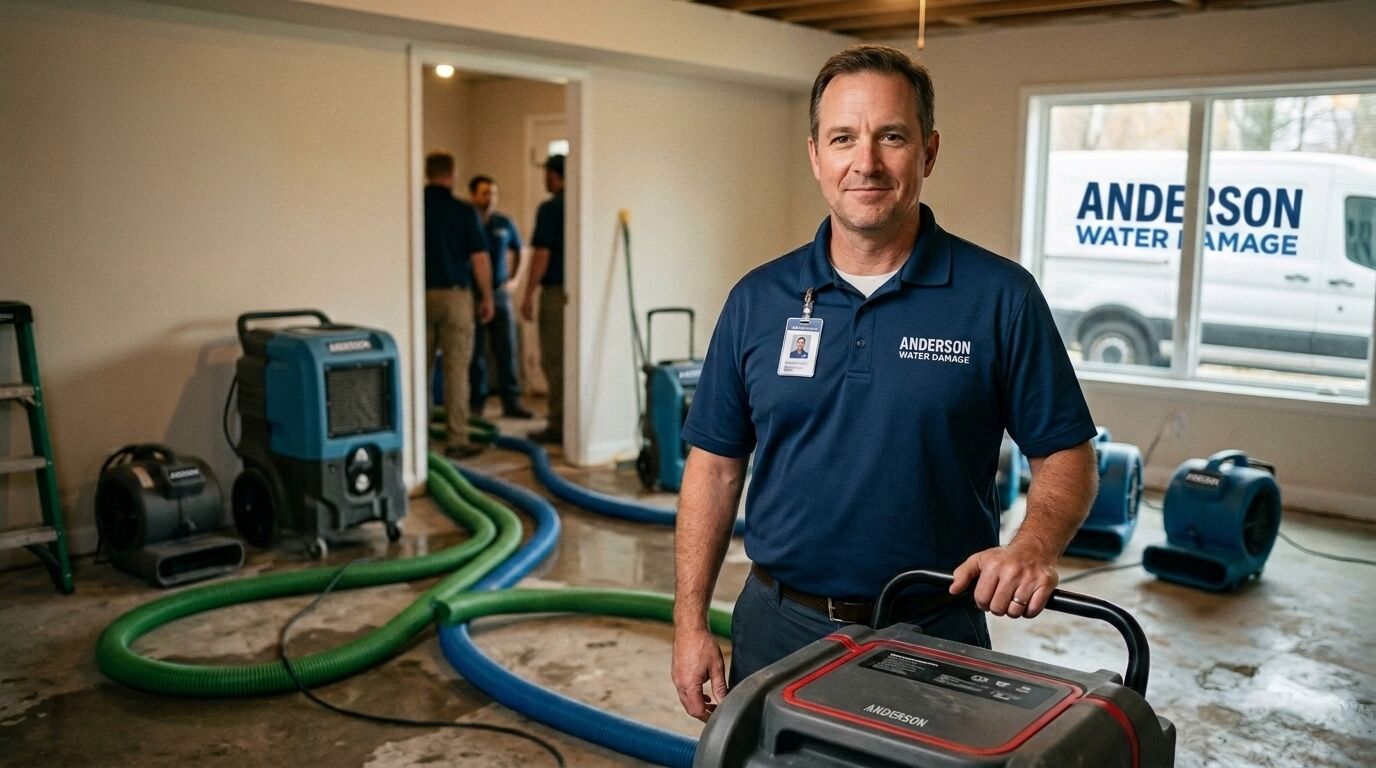
Standing water comes out first, then air movers and dehumidifiers run against a target based on readings from unaffected parts of the same building.
We recheck moisture until materials read normal, note what was removed, and tell you plainly what needs a contractor rather than a dryer.
Madison County sits in the White River corridor, and the ground around a lot of Anderson properties holds water longer than people expect after a heavy stretch of rain. Saturated soil pushes moisture toward foundation walls and floor slabs, which is why a basement that has been dry for years can take water during one unusual week.
Standing water is easier to handle early. Call 765-615-4599.
Questions
Not necessarily. Carpet is often savable when the water was clean and we reach it early, though the pad underneath usually is not. Drywall depends on how high the water wicked and how long it stayed. We take readings before deciding, so removal is based on what the materials actually hold rather than a guess.
Usually several days, and the range depends on the materials involved, how far the water traveled, and how humid the building is to start with. Dense materials like subfloor and framing release moisture slowly. We keep the equipment in place until readings match dry parts of the same building, rather than working to a fixed schedule.
Either order works, and stopping the water matters more than the sequence. We document what we find with readings, notes, and photos so you have a record for the claim. What your policy covers is a conversation with your insurer; we can describe the damage and the work, not the coverage decision.
Possibly. Surfaces dry long before the materials behind them do, and moisture trapped in a wall cavity or under flooring can stay wet for weeks. A meter check tells you quickly whether the structure is genuinely dry. Describe what happened when you call and we will tell you whether it is worth looking at.